
Simpson’s Rule
The most important rule in practice is Simpson’s Rule because of its simplicity and accuracy. When more accuracy is required, this rule should be used.
To find the area $$ABCD$$ as shown in the figure, the base $$AD$$ must be divided into an even number of strips of equal width $$S$$, producing an odd number of ordinates. The length of each ordinate $$a,b,c,d,e,f,g$$ is accurately measured. The first and the last ordinates are called the extreme ordinates; the second, fourth, sixth, etc., the even ordinates; and the third, fifth, seventh, etc. are the odd ordinates.
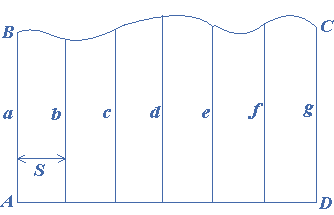
By Simpson’s Rule, the area is determined as:
Area $$ = \frac{S}{3}\left[ {A + 2D + 4E} \right]$$
Where $$A = $$sum of the first and the last ordinate
$$B = $$sum of the odd ordinates
$$E = $$sum of the even ordinates
$$S = $$width of each strip
Note: This rule is applicable only when there is an even number of strips or odd number of ordinates.
Example:
Find the area of an irregular figure whose ordinates are $$7.75$$, $$10.70$$, $$11.20$$, $$9.70$$, $$7.75$$, $$6.80$$, $$6.30$$, $$6.80$$ and $$2.00$$ respectively. The width of each strip is $$8.25$$m.
Solution:
Since the number of ordinates is odd, therefore we use Simpson’s Rule
Area $$ = \frac{S}{3}\left[ {A + 2D + 4E} \right]$$
Here $$S = 8.25$$m
$$A = 7.75 + 2.00 = 9.75$$
$$D = 11.20 + 7.75 + 6.30 = 25.25$$
$$E = 10.70 + 9.70 + 6.80 + 6.80 = 34$$
Area $$ = \frac{{8.25}}{3}\left[ {9.75 + 2\left( {25.25} \right) + 4\left( {34} \right)} \right]$$
$$ = 2.75\left( {196.25} \right) = 53.96$$ square meters.
Example:
A parabolic piece of cardboard from root to tip is $$12$$m long. At $$9$$ equidistant places, the widths are: $$0.0$$, $$1.3$$, $$3.7$$, $$4.0$$, $$4.8$$, $$5.8$$, $$6.2$$, $$6.9$$ and $$7.1$$m. Find its area.
Solution:
Since the Simpson’s Rule is
Area $$ = \frac{S}{3}\left[ {A + 2D + 4E} \right]$$
Here $$S = 12$$m
$$A = 0.0 + 7.1 = 7.1$$
$$D = 3.7 + 4.8 + 6.2 = 14.7$$
$$E = 1.3 + 4.0 + 5.8 + 6.9 = 18.0$$
Area $$ = \frac{{12}}{3}\left[ {7.1 + 2\left( {14.7} \right) + 4\left( {18} \right)} \right]$$
$$ = 4\left[ {7.1 + 29.4 + 72} \right] = 434$$ square meters.
Mangesh Shirdhankar
September 20 @ 4:00 am
1) Area formula to be changed as
Area=S/3(A+2B+4C) as you have explained B as sum of odd term and C as sum of even terms
or
Sums are to explained as “D as sum of odd term and E as sum of eventerms
2) Odd value 11.20 at third position is missing in first example.
[We edited the comment to show only our omissions and not the examples]
eMathZone
September 20 @ 12:40 pm
We have now corrected both, thank you very much.
Tuyishimire obedi
October 31 @ 12:47 pm
Why we multiply 4 on even and 2 on odd in this formula