
Continuous Random Variable
A random variable is called continuous if it can assume all possible values in the possible range of the random variable. Suppose the temperature in a certain city in the month of June in the past many years has always been between $$35^\circ $$ to $$45^\circ $$ centigrade. The temperature can take any value between the ranges $$35^\circ $$ to $$45^\circ $$. The temperature on any day may be $$40.15^\circ \,{\text{C}}$$ or $$40.16^\circ \,{\text{C}}$$, or it may take any value between $$40.15^\circ \,{\text{C}}$$ and $$40.16^\circ \,{\text{C}}$$. When we say that the temperature is $$40^\circ \,{\text{C}}$$, it means that the temperature lies somewhere between $$39.5^\circ $$ to $$40.5^\circ $$. Any observation which is taken falls in the interval.
There is nothing like an exact observation in the continuous variable. In a discrete random variable the values of the variable are exact, like 0, 1, or 2 good bulbs. In a continuous random variable the value of the variable is never an exact point. It is always in the form of an interval, and the interval may be very small.
Some examples of continuous random variables are:
-
The computer time (in seconds) required to process a certain program.
-
The time in which poultry will gain 1.5 kg.
-
The amount of rain falling in a certain city.
-
The amount of water passing through a pipe connected with a high level reservoir.
-
The heat gained by a ceiling fan when it has worked for one hour.
Probability Density Function
The probability function of the continuous random variable is called the probability density function, or briefly p.d.f. It is denoted by $$f\left( x \right)$$ where $$f\left( x \right)$$ is the probability that the random variable $$X$$ takes the value between $$x$$ and $$x + \Delta x$$ where $$\Delta x$$ is a very small change in $$X$$.
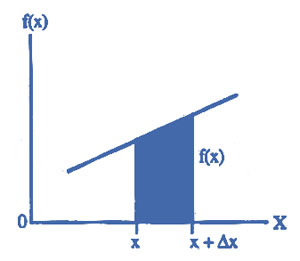
If there are two points $$a$$ and $$b$$, then the probability that the random variable will take the value between a and b is given by:
$$P\left( {a \leqslant X \leqslant b} \right) = \int_a^b {f\left( x \right)} \,dx$$
Here, $$a$$ and $$b$$ are the points between $$ – \infty $$ and $$ + = $$. The quantity $$f\left( x \right)\,dx$$ is called probability differential.
The number of possible outcomes of a continuous random variable is uncountable and infinite. Therefore, a probability of zero is assigned to each point of the random variable. Thus $$P\left( {X = x} \right) = 0$$ for all values of $$X$$. This means that we must calculate a probability for a continuous random variable over an interval and not for any particular point. This probability can be interpreted as an area under the graph between the interval from $$a$$ to $$b$$. When we say that the probability is zero that a continuous random variable assumes a specific value, we do not necessarily mean that a particular value cannot occur. In fact, we mean that the point (event) is one of an infinite number of possible outcomes. Whenever we have to find the probability of some interval of the continuous random variable, we can use any one of these two methods:
- Integral calculus
- Area by geometrical diagrams (this method is easy to apply when $$f\left( x \right)$$ is a simple linear function)
Properties of the Probability Density Function
The probability density function $$f\left( x \right)$$ must have the following properties:
- It is non-negative, i.e. $$f\left( x \right) \geqslant 0$$ for all $$x$$
- $${\text{Total}}\,{\text{Area}} = \int\limits_{ – \infty }^\infty {f\left( x \right)dx} = 1$$
- $$\left( {X = c} \right) = \int\limits_c^c {f\left( x \right)dx} = 0$$ Where c is any constant
- As the probability of the area for $$X = c$$ (constant), therefore $$P\left( {X = a} \right) = P\left( {X = b} \right)$$. If we take an interval a to b, it makes no difference whether the end points of the interval are considered or not. Thus we can write:
$$P\left( {a \leqslant X \leqslant b} \right)\,\,\,\, = \,\,\,\,P\left( {a < X < b} \right)\,\,\,\, = \,\,\,\,P\left( {a \leqslant X < b} \right)\,\,\,\, = \,\,\,\,P\left( {a < X \leqslant b} \right)$$ - $$P\left( {a \leqslant X \leqslant b} \right)\,\,\,\, = \,\,\,\,\int\limits_b^a {f\left( x \right)dx} – \int\limits_{ – \infty }^a {f\left( x \right)dx} \,\,\,\,\left( {a < b} \right)$$
Example:
A continuous random variable X which can assume between $$x = 2$$ and 8 inclusive has a density function given by $$c\left( {x + 3} \right)$$ where $$c$$ is a constant.
(a) Calculate $$c$$
(b) $$P\left( {3 < X < 5} \right)$$
(c) $$P\left( {X \geqslant 4} \right)$$
Solution:
$$f\left( x \right) = c\left( {x + 3} \right),\,\,\,\,2 \leqslant x \leqslant 8$$
(a) $$f\left( x \right)$$ will be the density functions if (i) $$f\left( x \right) \geqslant 0$$ for every x and (ii) $$\int\limits_{ – \infty }^\infty {f\left( x \right)dx} = 1$$. If $$c \geqslant 0$$, $$f\left( x \right)$$ is clearly $$ \geqslant 0$$ for every x in the given interval. Hence for $$f\left( x \right)$$ to be the density function, we have
$$1 = \int\limits_{ – \infty }^\infty {f\left( x \right)dx} \,\,\, = \,\,\,\,\int\limits_2^8 {c\left( {x + 3} \right)dx} \,\,\, = \,\,\,c\left[ {\frac{{{x^2}}}{2} + 3x} \right]_2^8$$
$$ = \,\,\,\,c\left[ {\frac{{{{\left( 8 \right)}^2}}}{2} + 3\left( 8 \right) – \frac{{{{\left( 2 \right)}^2}}}{2} – 3\left( 2 \right)} \right]\,\,\,\, = \,\,\,c\,\left[ {32 + 24 – 2 – 6} \right]\,\,\,\, = \,\,\,\,c\left[ {48} \right]$$
So that $$c = \frac{1}{{48}}$$
Therefore, $$f\left( x \right) = \frac{1}{{48}}\left( {x + 3} \right),\,\,\,\,2 \leqslant x \leqslant 8$$
(b) $$P\left( {3 < X < 5} \right) = \int\limits_3^5 {\frac{1}{{48}}\left( {x + 3} \right)dx} \,\,\, = \,\,\,\frac{1}{{48}}\left[ {\frac{{{x^2}}}{2} + 3x} \right]_3^5$$
$$ = \frac{1}{{48}}\left[ {\frac{{{{\left( 5 \right)}^2}}}{2} + 3\left( 5 \right) – \frac{{{{\left( 3 \right)}^2}}}{2} – 3\left( 3 \right)} \right]\,\,\,\, = \,\,\,\,\frac{1}{{48}}\left[ {\frac{{25}}{2} + 15 – \frac{9}{2} – 9} \right]$$
$$ = \frac{1}{{48}}\left[ {14} \right]\,\,\,\, = \,\,\,\,\frac{7}{{24}}$$
(c) $$P\left( {X \geqslant 4} \right) = \int\limits_4^8 {\frac{1}{{48}}\left( {x + 3} \right)dx} \,\,\, = \,\,\,\frac{1}{{48}}\left[ {\frac{{{x^2}}}{2} + 3x} \right]_4^8$$
$$ = \frac{1}{{48}}\left[ {\frac{{{{\left( 8 \right)}^2}}}{2} + 3\left( 8 \right) – \frac{{{{\left( 4 \right)}^2}}}{2} – 3\left( 4 \right)} \right]\,\,\,\, = \,\,\,\,\frac{1}{{48}}\left[ {32 + 24 – 8 – 12} \right]$$
$$ = \frac{1}{{48}}\left[ {36} \right]\,\,\,\, = \,\,\,\frac{3}{4}$$